Confirmed
Senior Backend Engineer
- HR, from the records
- Their manager
- A colleague
Three people, on these words.

For companies
References happen after the interviews are spent. By then the choice is made, and a bad answer costs you the whole process, so it almost never changes anything.
One vacancy is enough to see it. We set it up on your own careers page.
What you get instead
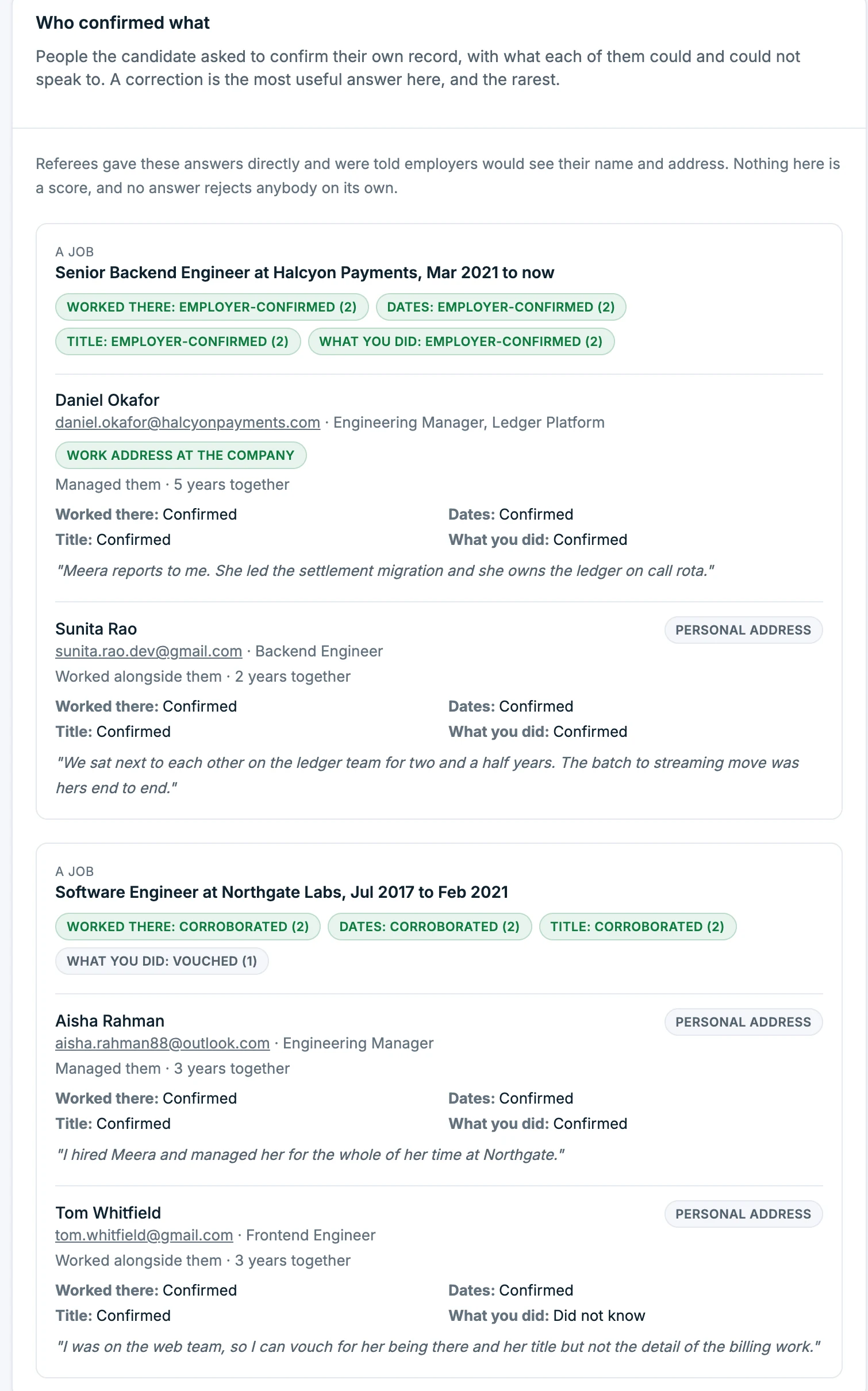
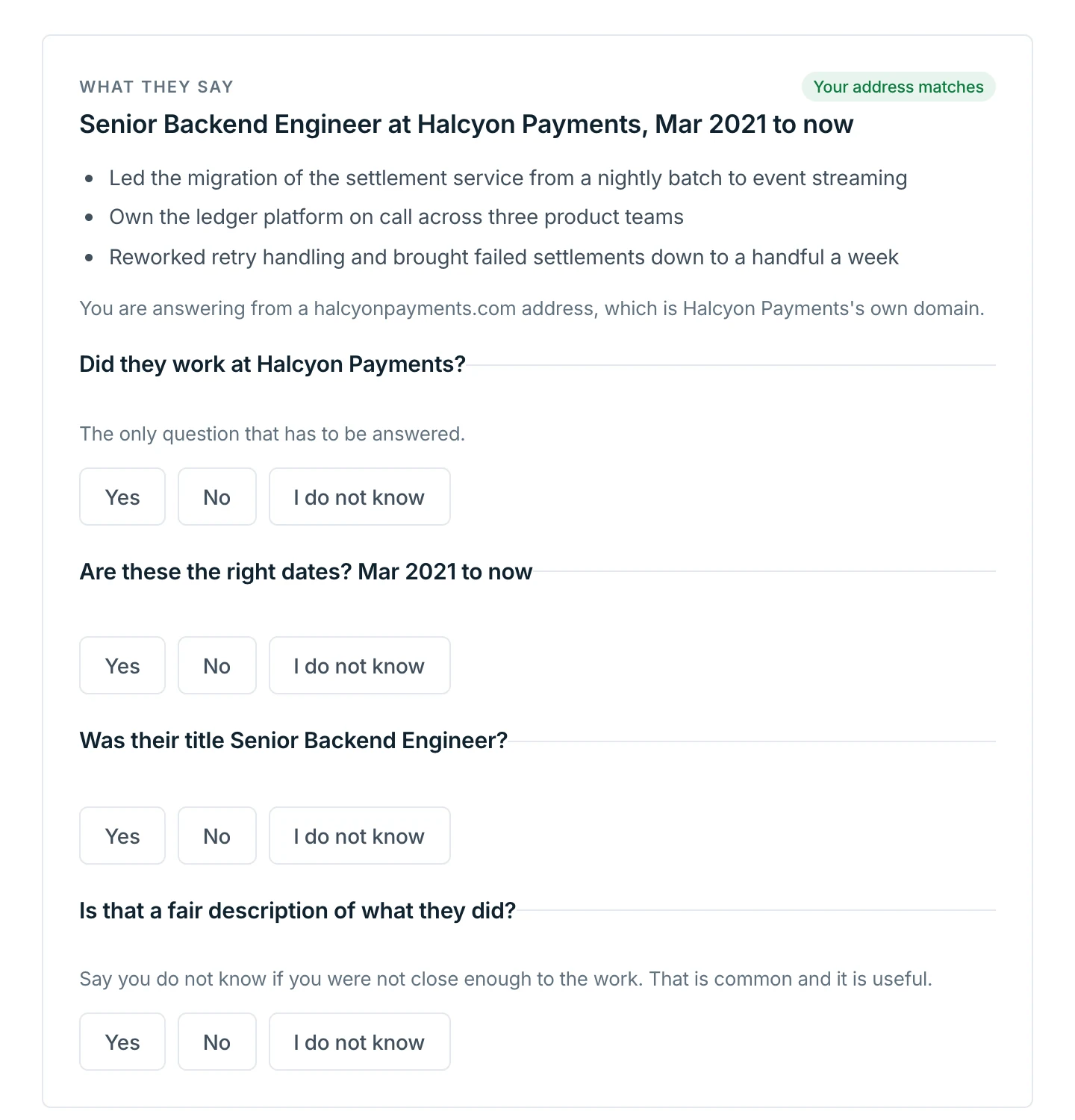
Different people honestly know different things. HR has the employment, the dates and the title. A teammate knows what the person actually did. Asking one referee all four is how you get a confident answer from somebody who was not in a position to give one.
So each fact carries its own answer and its own source, and I do not know is recorded as itself rather than rounded to a yes or quietly dropped.
The rules
A confirmation that can be replaced the same afternoon is worth very little. This is the part that decides whether any of the rest means anything.
Confirmed
Senior Backend Engineer
Three people, on these words.
the title is edited
No longer counts
Lead Backend Engineer
Kept on the record, so the candidate can see what was confirmed before they changed it. Counted for nothing.
Change the claim and the confirmation stops counting for the part that changed. A record cannot be rewritten to inherit somebody else’s answer.
Long enough that rewriting a claim to inherit its confirmations is slow enough to be visible rather than quiet.
A file somebody uploaded about themselves is shown to you and counted for nothing. Only an answer from a third party carries weight.
Nothing above the second confirmation changes what you learn. An uncapped count would become the thing candidates competed on.
A final decision on an application cannot be saved without one. The system refuses to store a rejection nobody stands behind.
Your careers page
Every company gets yourcompany.getrolepass.com, with your logo and your colour. Nothing on it carries our name.

Applications land in one place, each carrying the record behind it rather than a PDF you have to take on trust. You can add resumes you already hold, see which of them fit a vacancy, and put the role to the people who do.
Anybody on RolePass who has said they are open to a change can be found for a role they fit and written to about it. They are not handed to you as a contact: you hear from them only if they say they are interested.
Decisions
Automated screening is useful and it is also the thing that goes wrong quietly. A rejection nobody can account for is the one an employment tribunal, a regulator or a candidate will ask you about, and it is the one that is hardest to reconstruct a year later.
So a final decision cannot be saved without naming a person or a rule somebody reviewed. Rejections made by a rule go into a queue for a person to confirm, every read of a candidate's record is recorded against whoever made it, and the audit trail is scoped to your organisation at every source.
Before you ask
The full detail is in the privacy policy, including what is kept and for how long.
Get started
Tell us what you are hiring for and we will show you it on your own vacancies.