Skip to content

Hiring, on the record

Hiring runs on a document nobody believes.

A CV is what a person says about themselves. RolePass is what the people who were there confirm.

What you are asking a referee for: four questions, about a minute, no account to make. See exactly what they get.

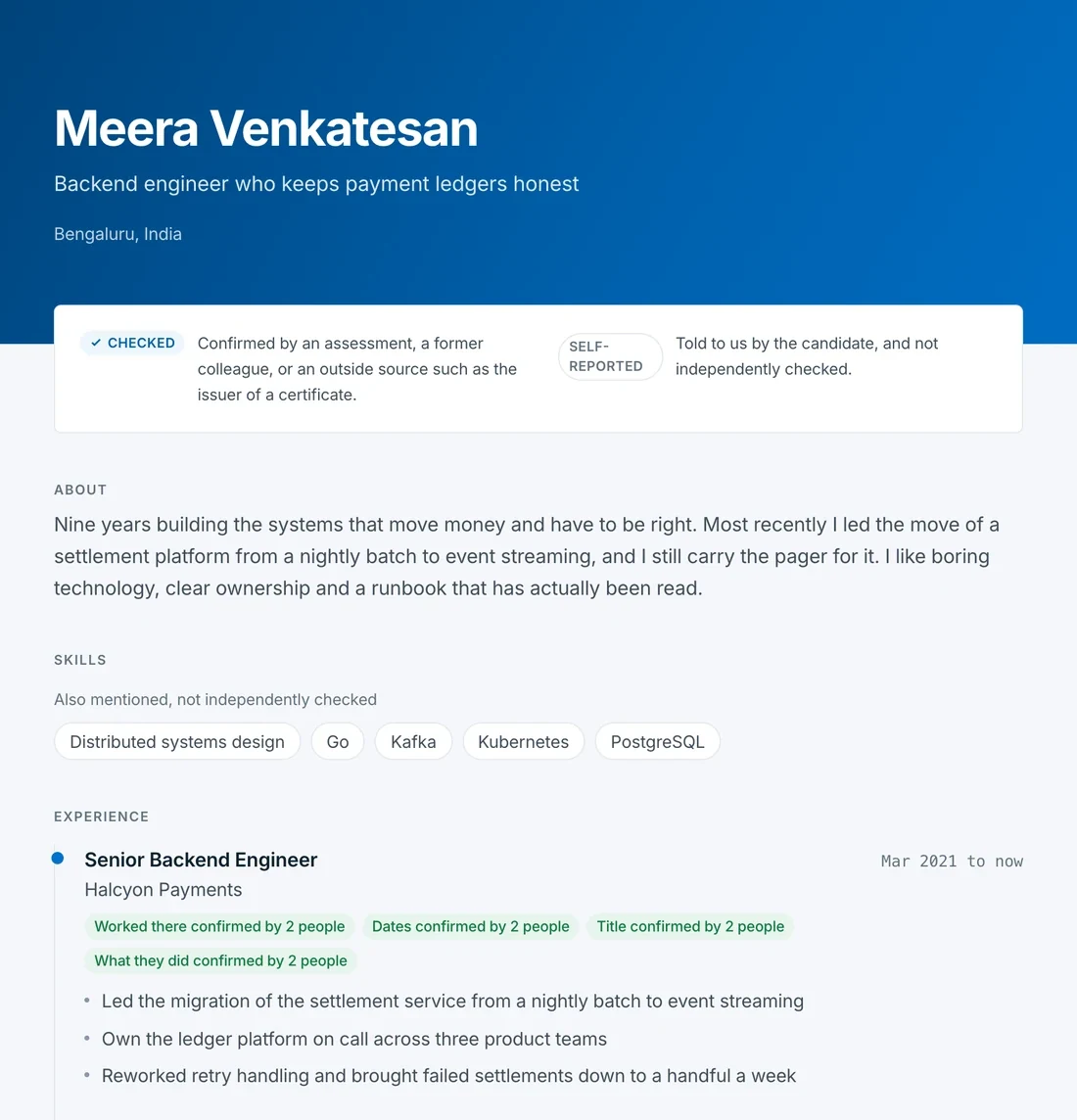
A candidate's public RolePass record. Under her name and headline, a legend separates what has been checked from what she has told us herself. Her current role at Halcyon Payments carries four marks: worked there, dates, title and what she did, each confirmed by two people.
A published record. Invented people, real product.
The same line, twice.

On a CV

Senior Backend Engineer

Halcyon Payments Mar 2021 to now

Led the migration of the settlement service from a nightly batch to event streaming

Every word of this is unverified, and the person reading it knows.

On RolePass

Senior Backend Engineer

Halcyon Payments Mar 2021 to now

Led the migration of the settlement service from a nightly batch to event streaming

  • Worked thereHR and two colleagues
  • DatesHR, from the records
  • TitleTheir manager
  • What you didTwo colleagues

Each mark names who said so. None of it is a score.

Invented people. Real product.

The problem

Everyone knows, and everyone pretends.

Nobody checks, because checking means a reference call at the very end, for one person, after the decision has largely been made. So the candidate writes the strongest version they can defend, and the employer discounts it by a private amount.

A document, a discount, and a conversation to make up the difference. That is the whole system.

How it works

A role is four facts, not one.

Different people honestly know different ones. HR has the employment, the dates and the title. A teammate knows what you actually did. So we ask four questions, and I do not know is a real answer to each.
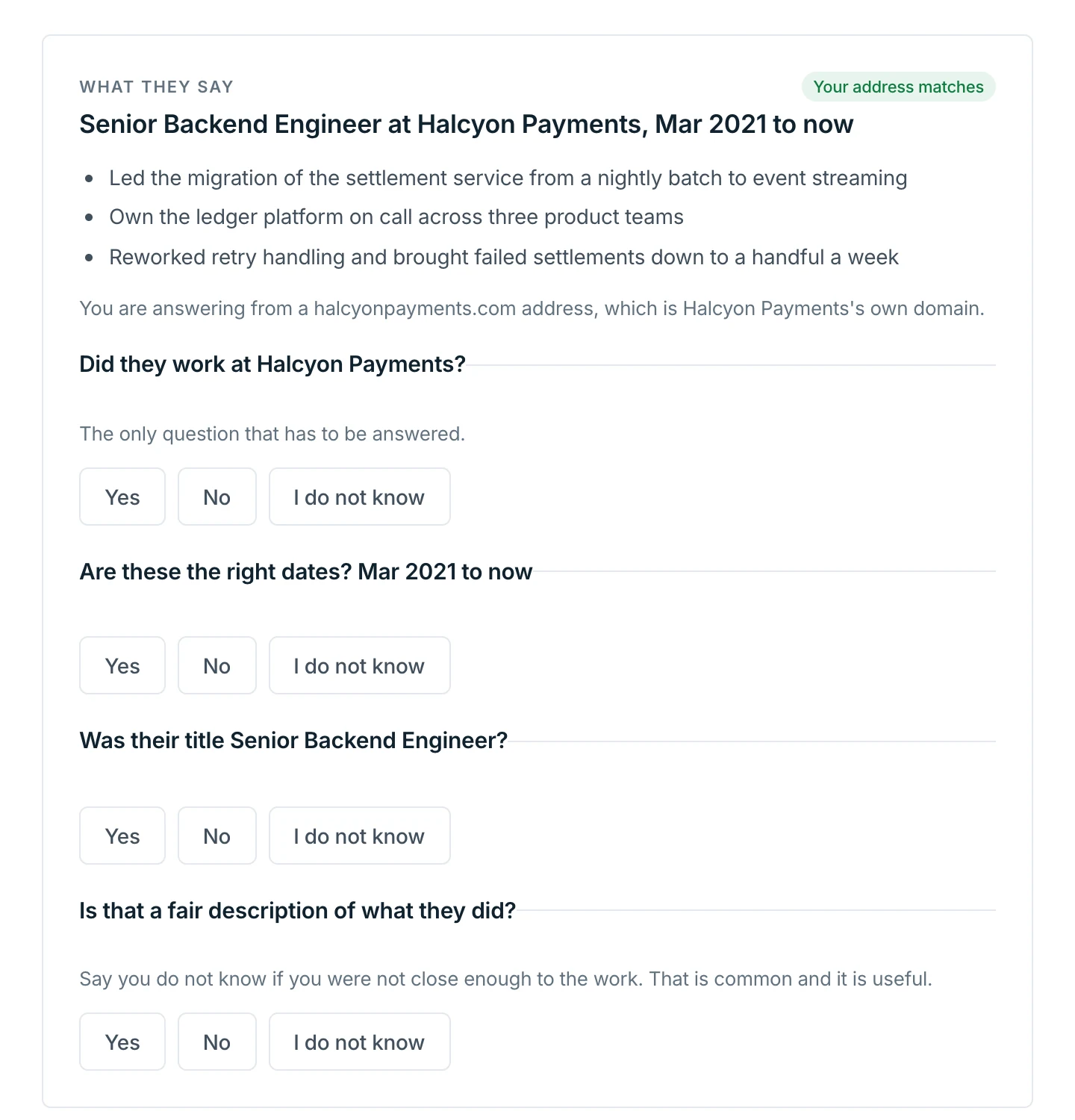
  • Worked thereThe one that has to be answered
  • DatesMeasured against when the referee was there
  • TitleA correction is welcome, and kept
  • What you didOnly from somebody close to the work
The page a referee sees. It restates the claim, Senior Backend Engineer at Halcyon Payments, March 2021 to now, notes that the referee is answering from the company's own domain, then asks four questions in turn, each with three buttons: Yes, No, and I do not know.
What a referee sees. No account to make, no form beyond the four questions.

What it is worth

Who said so, and what that is worth.

The one thing a candidate cannot fabricate is the referee's mailbox. We show that difference rather than averaging it away.

  1. Self-reported

    Where every fact starts.

  2. Vouched

    One person, from a personal address. Deliberately not called checked.

  3. Corroborated

    Two people agree. Counting stops at three.

  4. Employer-confirmed

    A live mailbox at the company itself. No number of personal confirmations reaches it.

None of this is a score.

No number out of five, no ranking, nothing to farm. A level says what happened and who said so.
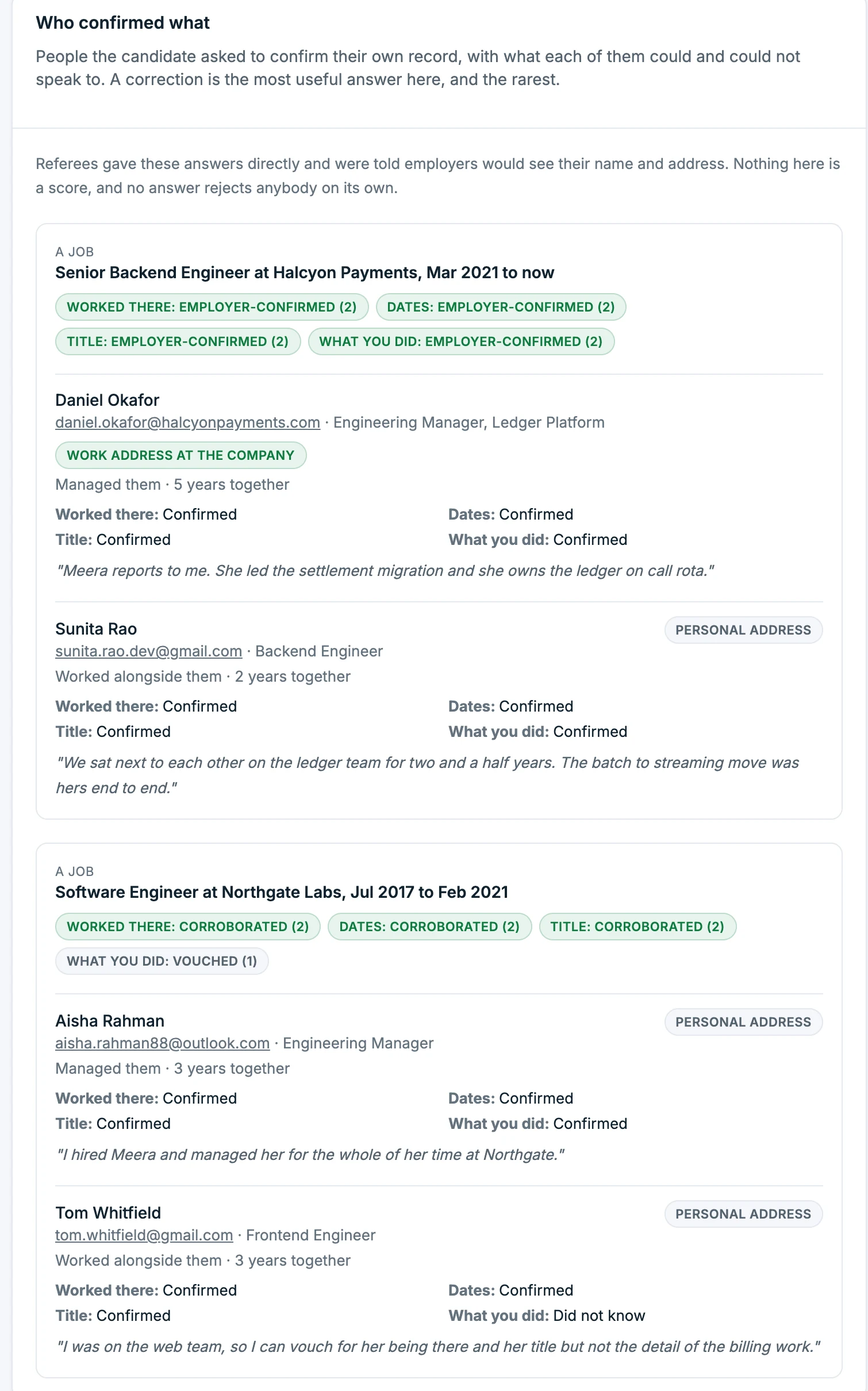
The employer's view of the same record, headed Who confirmed what. The current role shows four facts each marked Employer-confirmed with a count of two. Beneath it, one referee is labelled Work address at the company and the other Personal address, with each of their four answers listed. An earlier role shows Corroborated for three facts and Vouched for what she did, because one colleague answered I do not know to that one.
What a hiring team sees. Referees are named here, never on the public page.

The rules

Built so it cannot be gamed quietly.

A confirmation that can be replaced the same afternoon is worth very little.

Confirmed

Senior Backend Engineer

  • HR, from the records
  • Their manager
  • A colleague

Three people, on these words.

the title is edited

No longer counts

Lead Backend Engineer

  • HR, from the records
  • Their manager
  • A colleague

Kept on the record, so the candidate can see what was confirmed before they changed it. Counted for nothing.

  1. 01

    A confirmation is bound to the words it confirmed.

    Change the words and the confirmation stops counting.

  2. 02

    A confirmed fact is held for thirty days.

    Long enough that rewriting a claim to inherit its confirmations is slow enough to be visible.

  3. 03

    One person counts once.

    However many times they are asked, and however they spell their address.

  4. 04

    A dispute is shown, not subtracted.

    A disagreement is not a negative vote to net off against the yeses. A hiring team sees what it is: one person said something different, from this kind of address. The candidate can correct the claim and ask for the correction to be confirmed, and only a live mailbox at that employer can hold a claim down.

  5. 05

    Nothing the candidate controls is counted.

    A file they uploaded is shown to employers, and counted for nothing.

For companies

Your careers site, at your own address.

Every company gets yourcompany.getrolepass.com, with your logo and your colour.

Applicants arrive with their record already made, so your team sees who confirmed what before the first conversation. Corrections are shown first.

A company's careers page on RolePass. The company's own logo sits top left on a full width band in their own blue, headed Careers at Thinkscoop Technologies, with Find your next role beneath it and a search box for job titles. Nothing on the page carries the RolePass name.
A company hiring on RolePass today. Their logo, their colour, their address, and not a mockup.
  • Where the data sitsOur own infrastructure in Asia Pacific (Mumbai). Files are private and reached only through short lived links.
  • Who can see itOnly the company a candidate applied to. Companies never browse each other's candidates, and an agency's end client is never named to a candidate.
  • What we stripDate of birth, gender and marital status are removed from a CV before any automated step sees it.
  • What your team getsEvery application carries an evidence report your hiring manager can be sent. There is no applicant tracking integration yet.

The full detail is in the privacy policy, including what we keep and for how long. A final decision on an application has to record a person or a rule somebody reviewed; the system refuses to save one that nobody stands behind.

Tell us what you are hiring for and we will show you it on your own vacancies.

For candidates

Collect it once. It is yours.

Your record lives at getrolepass.com/resume/your-name. You ask the people who were there once, and every company you apply to sees the same answers.
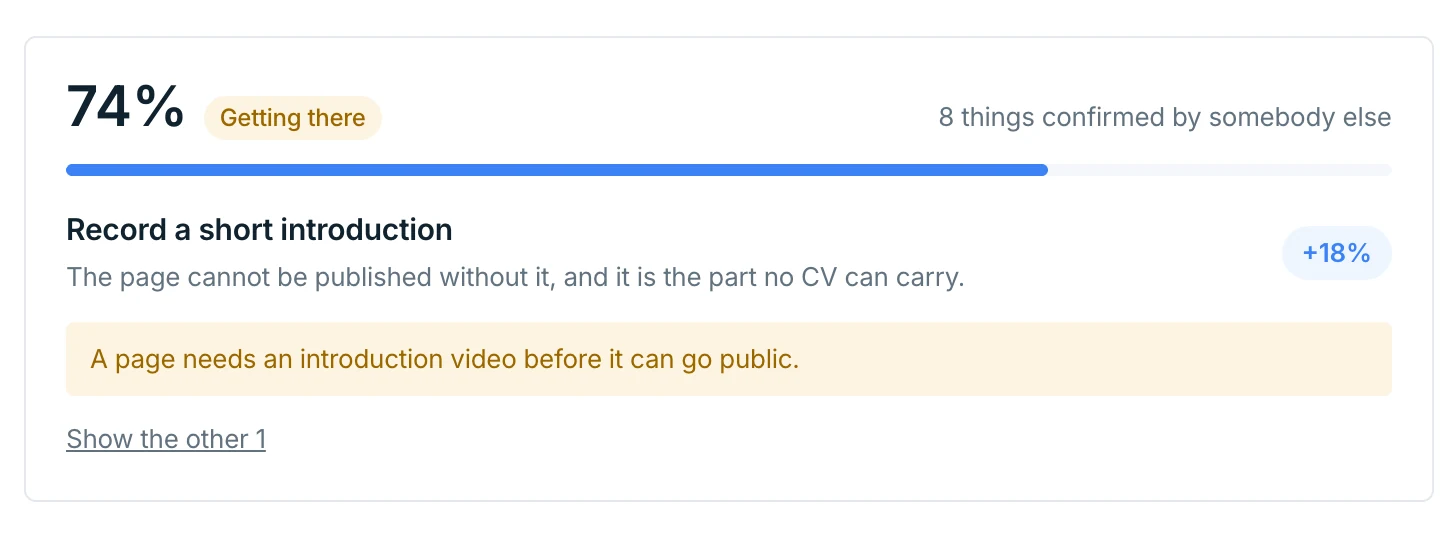
The strength meter at the top of a record: 74 per cent, labelled Getting there, with eight things confirmed by somebody else. Beneath the bar, one suggested step: record a short introduction, worth 18 per cent, with a note that a page needs an introduction video before it can go public.
One next step, not a list of twelve.
What if I ask someone and they never reply?
Nothing happens to your record, and you can withdraw the request and ask somebody else. An unanswered ask is not a mark against you and is never shown to an employer.
What if a referee says something different?
It is kept as a correction rather than replacing your version, and you can change the claim to match and ask for that to be confirmed. A confirmation you have since superseded does not use up one of your three places. A disagreement from a personal address is shown and does not hold a claim down; only a live mailbox at that employer can do that.
Do I have to record a video?
Only to publish a public page. You can build your record, collect confirmations and apply for jobs without one.
Why only three people per role?
Because three is the most that can count towards a fact. A fourth confirmation of a job title tells an employer nothing the second did not, and twenty people emailed about one job is a favour nobody asks twice.
  • Free for candidates, always.
  • Your files are encrypted in transit and at rest, and are never public.
  • Your referees are never named on your public page.
  • Take your page down whenever you like. A role you remove takes its confirmations with it.
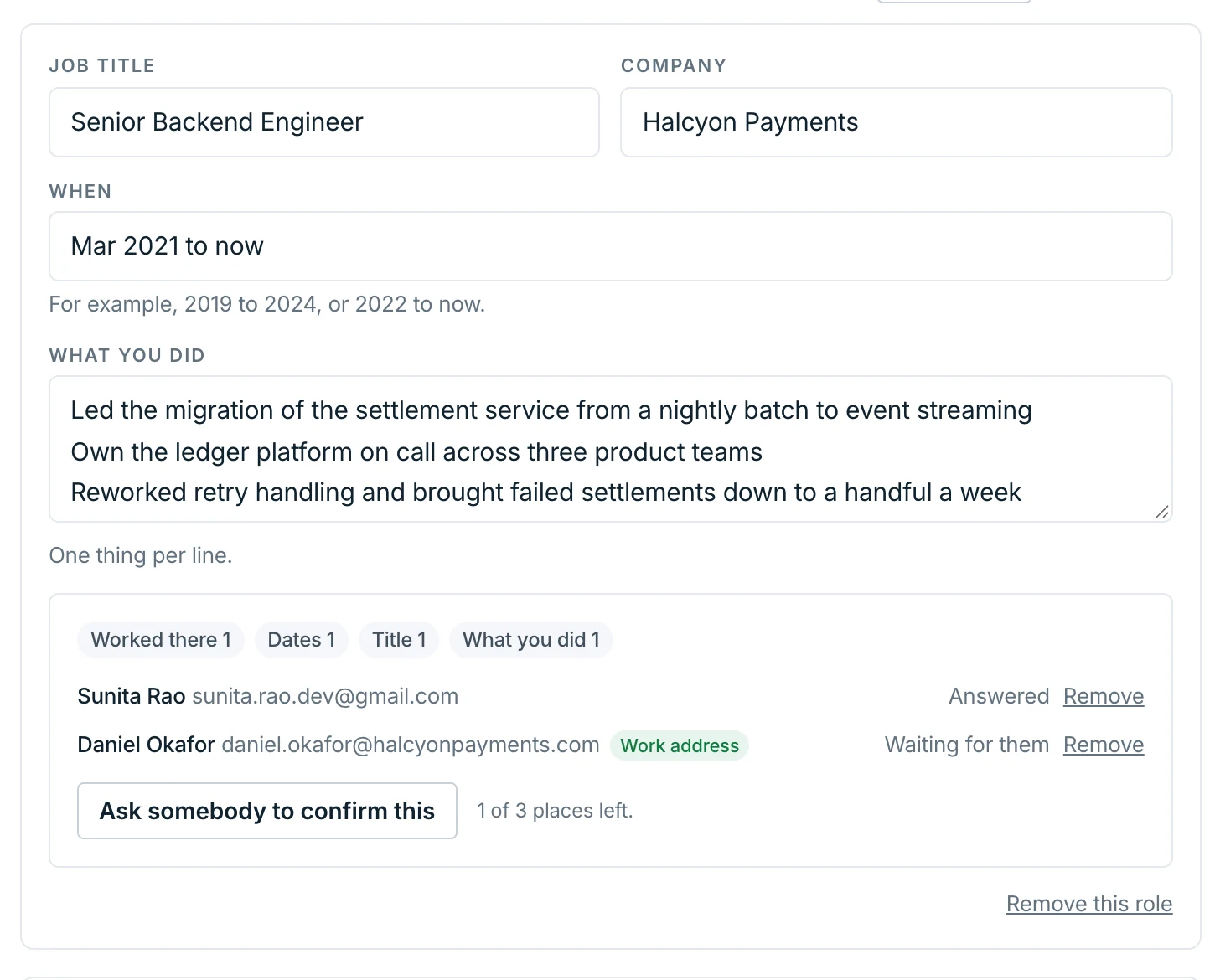
Editing a role on your own record: job title, company, dates and what you did, each in its own field. Below them, a strip shows how many people have confirmed each fact, the two referees asked so far with their status, and a button reading Ask somebody to confirm this, with one of three places left.
Each role carries its own confirmations.

Sana Qureshi

Backend engineer, four years in

Backend Engineer

Meridian Freight Aug 2023 to now

  • Worked there
  • Dates
  • Title
  • What you did

Junior Developer

Meridian Freight Jan 2022 to Aug 2023

  • Worked there
  • Dates
  • Title
  • What you did
Two jobs, one of them a first. Six facts confirmed, two not yet. A short record with answers against it says more than a long one without.

In their own words

There are things no document has ever carried. Every published record opens with a short introduction, recorded in the browser, because it is the first thing most people watch and the part a page cannot hold.

On their own initiative

The part of a CV with nothing behind it.

A talk, a library other people depend on, a side project with real users. Often the most interesting thing about somebody, and the part of a CV with no evidence at all.

  • Counts mostA page on the organisation's own domain that names the person.
  • CountsA registry anybody can post to but nobody can forge: a DOI, a repository, a package index.
  • Shown, never countedA site the candidate controls. A PDF proves somebody has a PDF.

A CV is what a person says about themselves. This is what the people who were there confirm.

For hiring teams

For the person

I want mine
on the record.

Your record, your applications and everything anybody has confirmed.

I am a candidate

Your CV, with witnesses.

For the team

I want to know
it is true.

Your jobs, your applicants, and who confirmed what before the first conversation.

I am hiring

The references, before the interview.

Nearly there

Which company’s
careers page?

Your account is the same one everywhere, so this only decides which page you land on.

The first part of the address on their careers page.