On a CV
Senior Backend Engineer
Halcyon Payments Mar 2021 to now
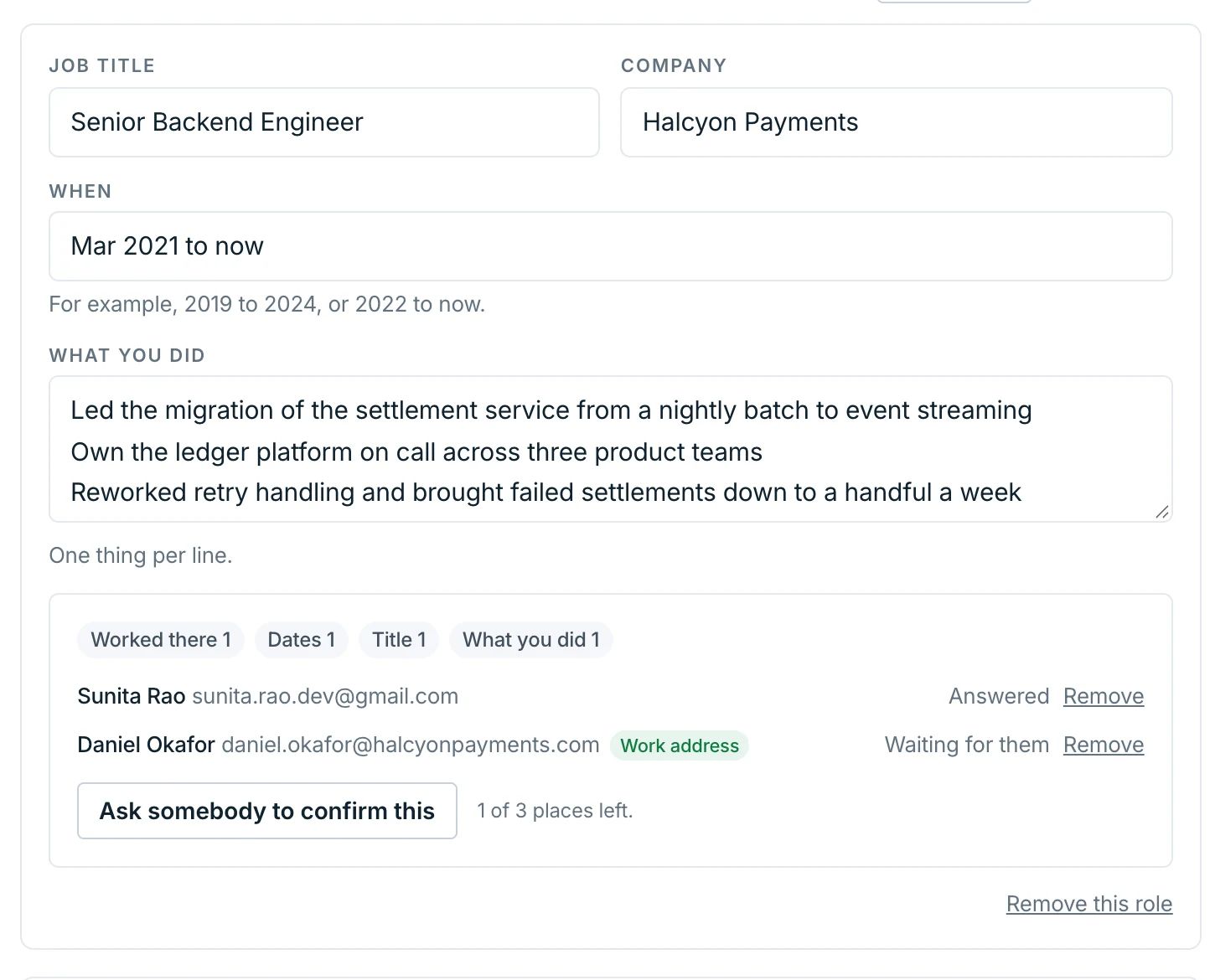
Led the migration of the settlement service from a nightly batch to event streaming
Every word of this is unverified, and the person reading it knows.

For candidates
That is not a criticism, it is the format. Nobody asked the people you worked with, so nobody can tell a careful account from a generous one.
Free. Nothing is public until you publish it, and you can take it down again.
The cost of the format
Two people write the same line. One of them led the work and one of them sat near it. On a CV those are the same sentence, so a reader has to discount both.
On a CV
Senior Backend Engineer
Halcyon Payments Mar 2021 to now
Led the migration of the settlement service from a nightly batch to event streaming
Every word of this is unverified, and the person reading it knows.
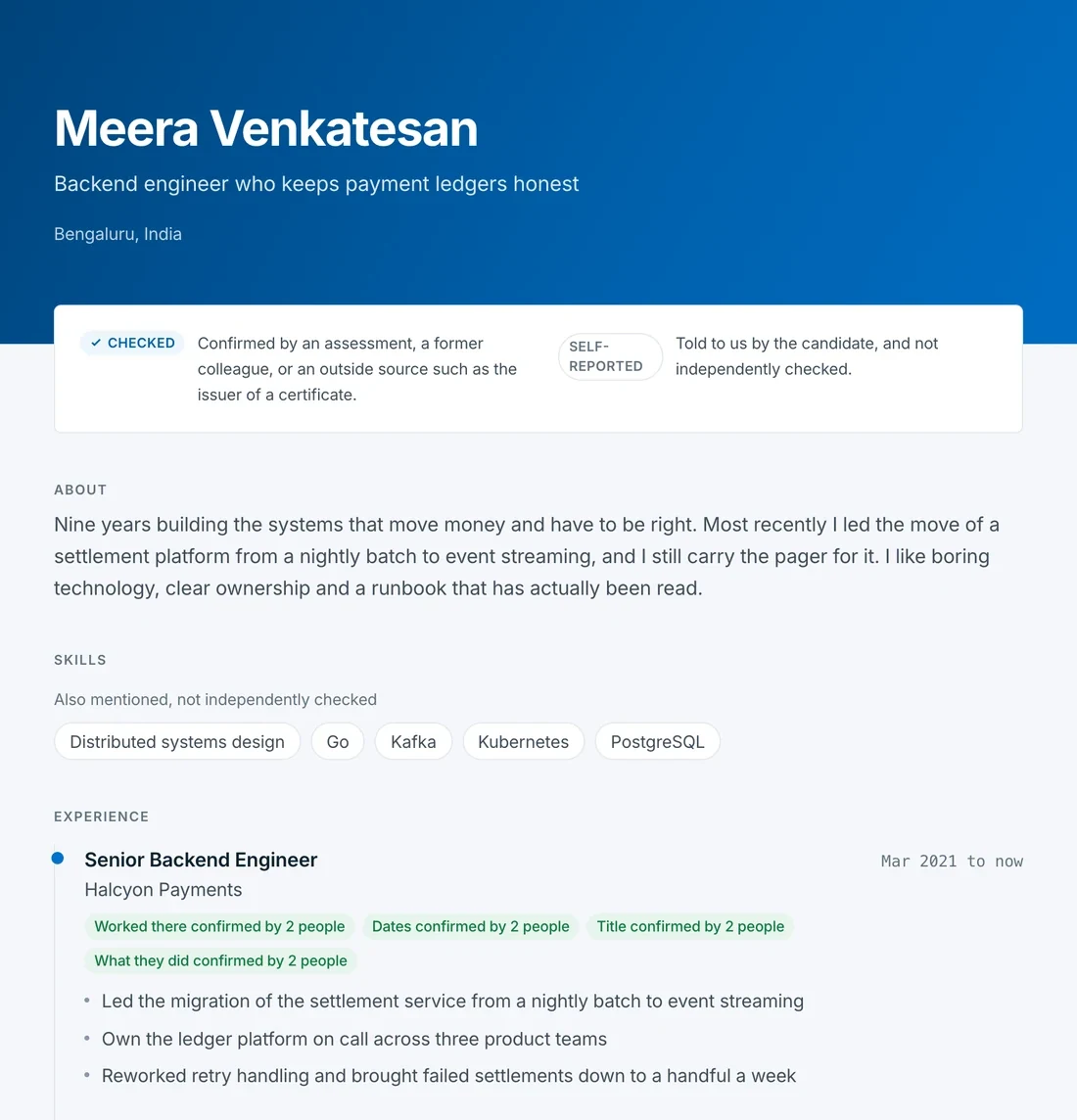
On RolePass
Senior Backend Engineer
Halcyon Payments Mar 2021 to now
Led the migration of the settlement service from a nightly batch to event streaming
Each mark names who said so. None of it is a score.
Invented people. Real product.
This is the part that is not your fault and that you cannot fix by writing better. The only thing that separates the two lines is somebody else being willing to say which one is which, and a CV has nowhere to put that.
What you are asking
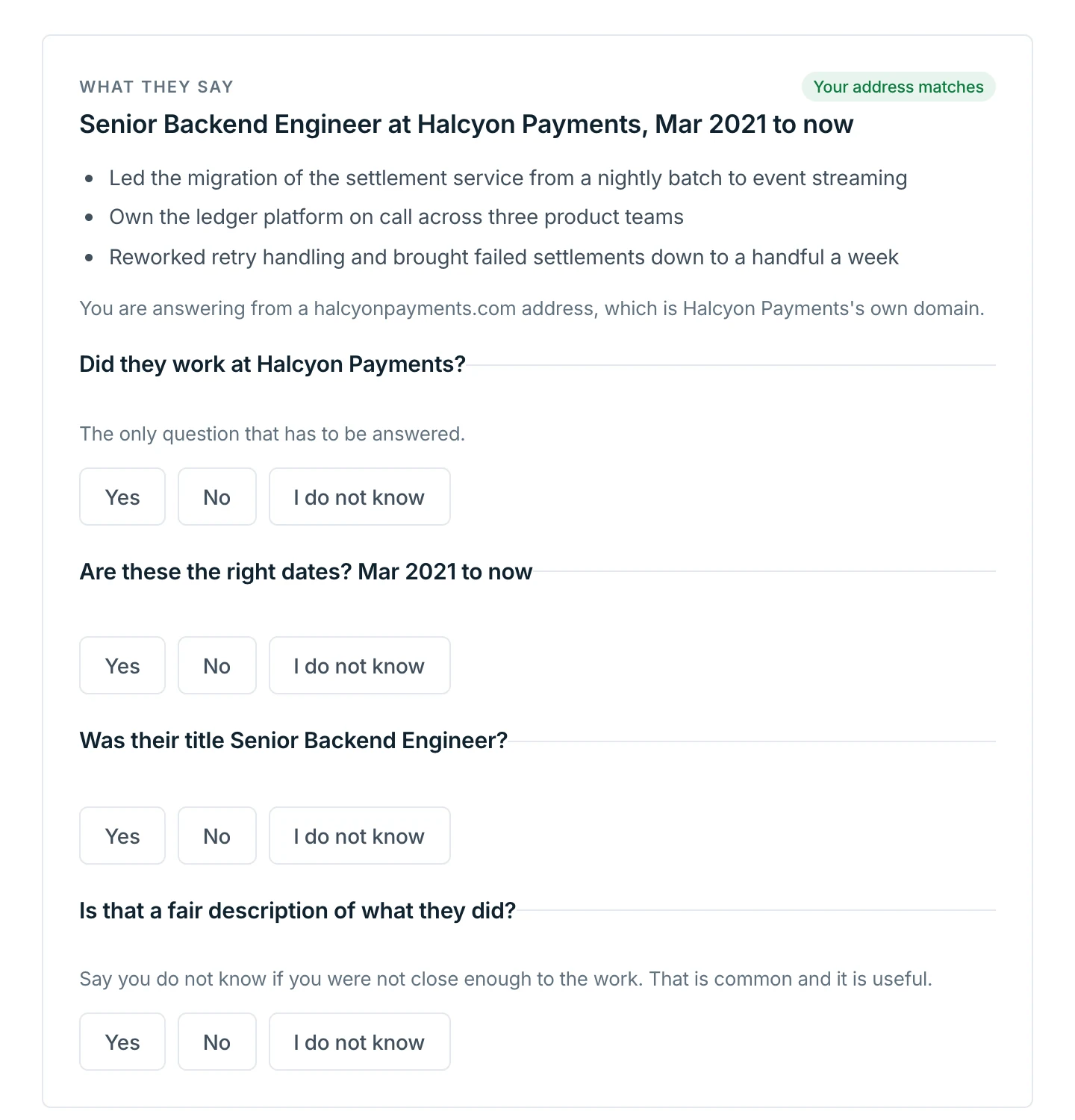
This is the part people stall on, and it is worth being exact about, because what you picture is emailing a former manager and hearing nothing.
They make no account. They answer four questions about one person, and I do not know is a real answer to each one, more useful than a guess. If they disagree, they are asked what it should have said instead, and the correction is kept.
If they never reply, nothing happens to your record and you can ask somebody else. Nothing you have already built is affected.
What an answer is worth
A number invites somebody to read a 62 as a rejection. These are four named states, and an employer sees which one each fact stands at.
Where every fact starts, including on a CV. Shown, and counted for nothing.
A colleague who was there answered. Their name is never on your public page.
Two people agree, independently. Counting stops at three, so this is not a numbers game.
Answered from an address at the company itself, which is the strongest thing a record can carry.
Building it
Upload a CV and we read it in, so you are correcting rather than typing. It is stored privately and no company sees it unless you apply to them.
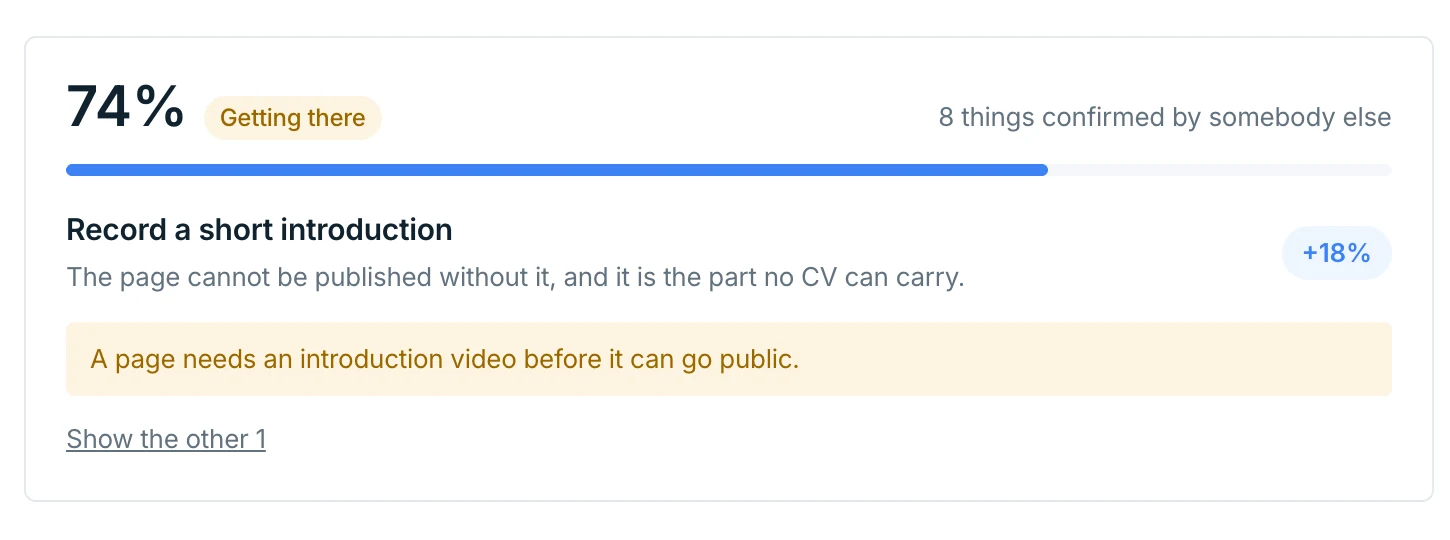
The meter is not a game. It says what is still missing and what each thing would add, so you can stop when it is good enough rather than guessing.
In your own words
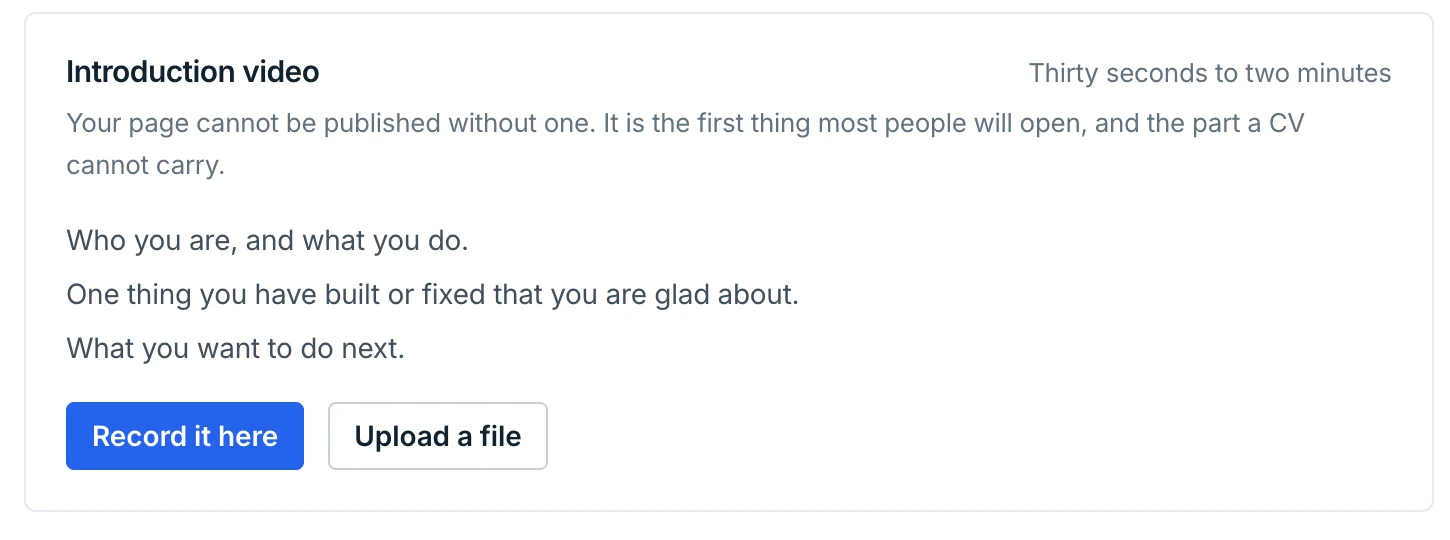
A short introduction you record once. It is the only part of a record that is not a fact somebody else checked, and it is the part that gets read first.
It is also the thing a screening process usually strips out. Somebody reading forty applications meets forty documents; this is the one where they meet you.
On your own initiative
The thing you built on your own, the course you finished, the project nobody employed you for. No former manager can confirm any of it, and pretending otherwise would be the same dishonesty this whole idea objects to.
So those sit on your record marked as what they are: your own account, with the evidence you can point at. A certificate is checked against whoever issued it. The rest is read, by a person, on its merits.
If you are early on
Every screen on this site shows somebody nine years in. Here is what two jobs looks like, because that is the question that decides whether this is for you.
Sana Qureshi
Backend engineer, four years in
Backend Engineer
Meridian Freight Aug 2023 to now
Junior Developer
Meridian Freight Jan 2022 to Aug 2023
What it costs you